The more consciously I try to improve, the worse I perform. My mental clarity, energy and emotional stability all wobble — a paradox I didn’t see coming.
It’s an occupational hazard of leadership coaching to keep learning and developing. As a lifelong learner, I chase each new finding in neuroscience and leadership development, where certainties shift every season.
I follow these discoveries hoping they’ll make me more capable, more useful. Embarrassingly, they also feed a quiet panic that I’m perpetually behind.
Recently, I was exhausted enough to find solace in a duvet day, a day spent undercover in my PJs. Too tired to do anything, I was quiet enough to observe my life. The heavy storm outside encouraged reflection.
For most of my life this drive has benefited my work – until it doesn’t. It has repeatedly pushed me past exhaustion, flat on my back, drained, the recovery slow.
Beneath my drive, a flawed script keeps running — ‘not enough’. It’s code written for self-repair, not self-respect. It’s running when I register for a new course, write a proposal, write this essay.
Somewhere along the line I set about striving to meet impossible, self-imposed standards. These standards tell me lies: more discipline and emotional control will finally make me acceptable.
To make it worse, I resist asking for support because if I refuse self-acceptance as a viable option for myself, I presume others will also deny me.
Lies. Lies. Lies.
I noticed how I have over-invested in self-improvement, including closing gaps in my knowledge. I hate to admit that too much of my self-improvement has been a vain attempt to overcome a basic fear of being overwhelmed.
I have been driven to be self-sufficient — competent enough not to depend on anyone, resourced enough to steer my own course. The fear compels me to constantly improve myself and increase my capacity.
Chronic fear is rarely a wise advisor.
It has blinded me to a syntax error in my thought process: learning → self-comparison → self-criticism → lower performance.
It’s those twin habits of self-comparison and self-criticism that turn learning from fuel into friction. Far from improving me, self-criticism makes me worse.
If I can soften self-comparison and self-criticism — I doubt I’ll ever delete them — learning leads more directly to performance.
If I lean more into clarifying why an activity really matters, practising truth-telling especially naming my needs directly, and trusting that I am enough, my self-comparison and self-criticism soften
Mercy is catching the faulty loop before it runs again, compassionately rewriting one small line of code at a time.
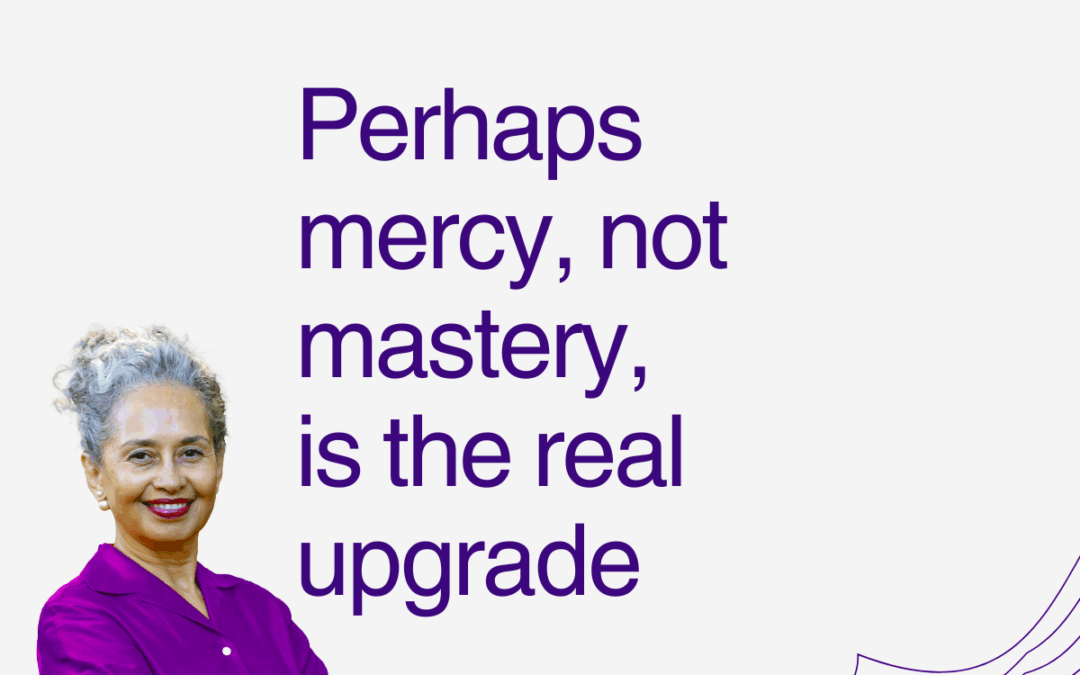
Not by effort. Not by mastery. Only by mercy.