At some point, most of us ask, who am I, really?
The question isn’t just philosophical. It’s personal, urgent, and unsettling. And deeply human.
Psychologists and neuroscientists might describe the self as an emergent property of biology and experience — a construct shaped by memory, perception, and cultural feedback loops. Some spiritual traditions go further, claiming the self is an illusion altogether, a story we tell ourselves and mistake for truth.
And yet, others speak of a higher self — an inner witness motivated not by fear or scarcity, but by love, compassion, wonder, and connection. This self seeks not just survival but meaning and growth.
For a long time, I flipped between these views. Now, I believe both can be true at once.
The more I learn about neuroscience, the more I respect the biology of my brain — and the powerful role that environment and culture play in shaping my identity.
According to research, I wasn’t born with a sense of a separate self. At the beginning, I didn’t know the difference between myself and my mother. Over time, through billions of neurons interacting dynamically, my sense of “I” emerges — built from memory, perception, relationships, and reflection. In truth, my identity has been cobbled together from what I learn both consciously and carelessly.
Some parts serve me well. Others have outlived their usefulness. It’s humbling to realise that some strategies that once helped me survive are holding me back. What once felt solid proves to be fluid.
Research tells us the brain continues to change — physically and functionally — across time, trauma, training, and transformation. That means my experience of body, memory, and even personality can also change, sometimes dramatically. Identity is not fixed. It is adaptable.
Even now, my sense of self keeps evolving — shaped by loss, learning, context, and even by technology. (Yes, even AI has changed how I think about what it means to be human.) But this mutability is not a flaw. It’s a gift. It means I’m not bound by outdated narratives or inherited traits.
If identity is malleable, multi-faceted, and emergent, then individuals and teams can reimagine themselves. We can respond to new environments, relationships, and purposes with intention. We can evolve into the people the moment requires.
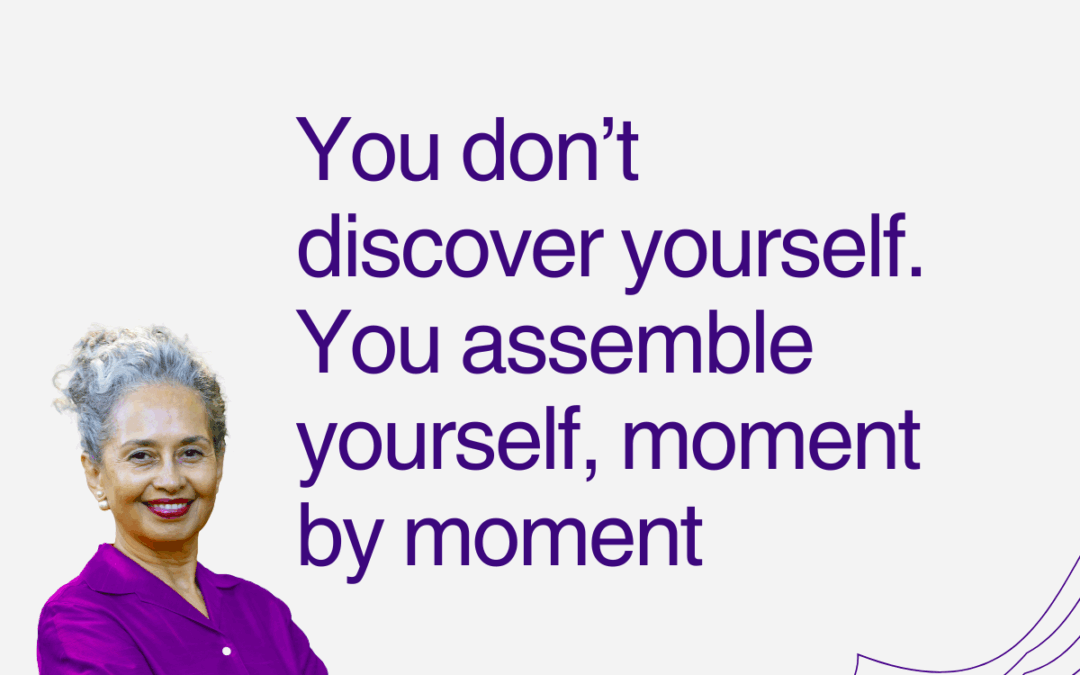
The self, then, is not a fixed thing to be found — like a buried treasure or hidden truth. It is a living process. Always unfolding. Always becoming.
For anyone facing uncertainty or a challenge that feels beyond their current identity, this is liberating: we’re not stuck. We can evolve, lead, and rise to meet what the world asks of us — even when it feels unfamiliar or hard.
And that, to me, feels like grace. Even sacred.